
50/50 Is a Lie
Splitting everything equally sounds fair. It's not. Here's why, and what couples who've figured it out do differently.
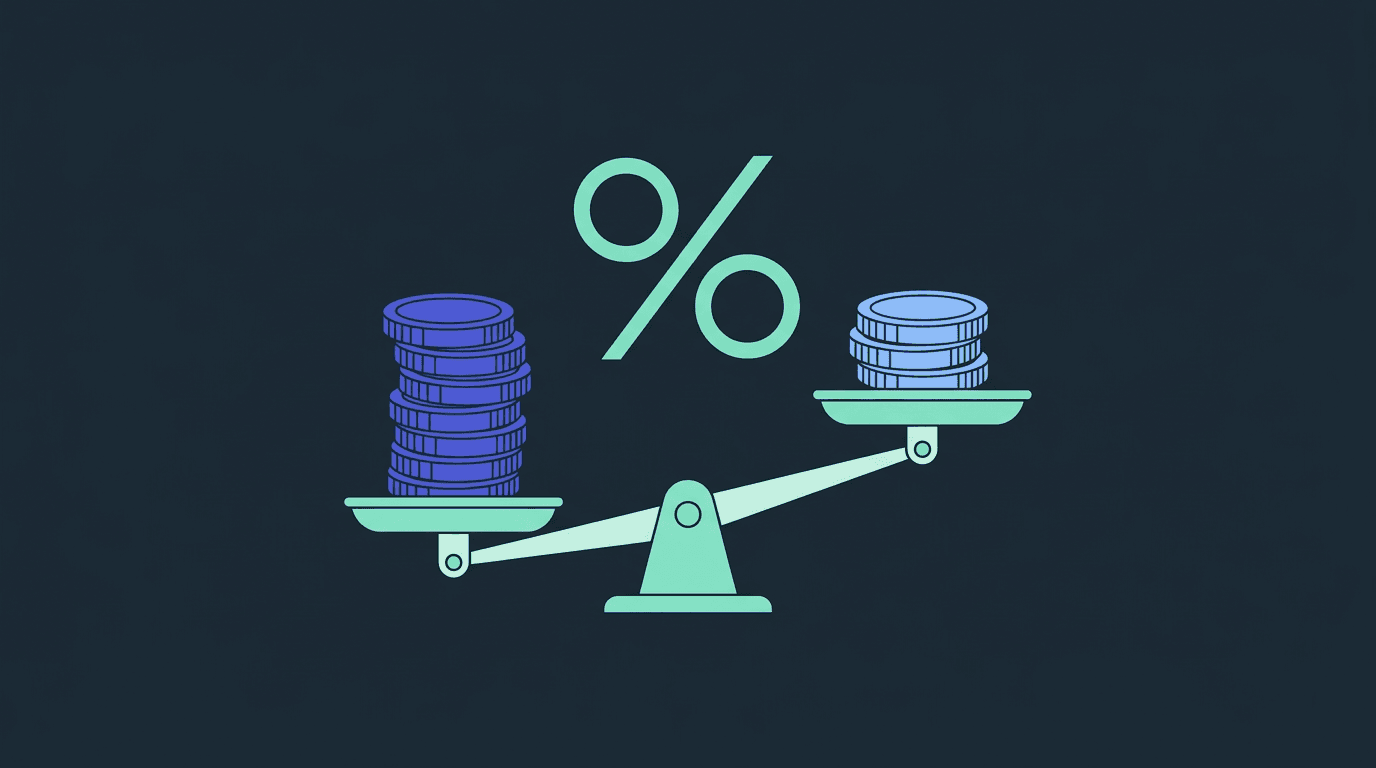
You split everything down the middle because nobody showed you another way
When you move in together, 50/50 is the obvious starting point. It feels clean, democratic, fair. Nobody's keeping score. Nobody's the "provider." You're equals, and the money reflects that.
Except it doesn't. Not if your incomes aren't equal. And for most couples, they're not.
Here's a quick exercise. Let's say you earn $95,000 a year and your partner earns $42,000. Your combined income is $137,000. Now you go out for dinner and the bill is $120. You split it 50/50: $60 each.
For you, that $60 is 0.06% of your annual income. You won't think about it tomorrow. For your partner, it's 0.14%, more than double. That dinner took a measurably larger bite out of their financial life than yours. As one analysis put it: "$50 from someone earning $95,000 is a rounding error. $50 from someone earning $42,000 is a budget decision."
One dinner doesn't matter. But rent, groceries, utilities, insurance, subscriptions, date nights: all split 50/50, month after month. That's a structural disadvantage that grinds the lower earner down quietly.
And here's the thing: the higher earner usually has no idea. Not because they're selfish or oblivious, but because when you're comfortable, you don't inventory your partner's stress. You split the check and move on. Your partner splits the check and mentally recalculates whether they can afford the parking garage tomorrow. Same dinner, completely different experience of it.
Most people know it's unfair. They do it anyway.
A YouGov survey asked people two questions: What's the fairest way to split bills? And how do you actually split them?
When asked about fairness, 48% said proportional to income. Only 37% said 50/50. But when asked about practice, the numbers reversed: 46% said they split 50/50, and only 38% split proportionally.
People know the right answer. They just can't get there.
Three things get in the way, and they're all rooted in psychology.
First, the conversation itself triggers what behavioral scientists call loss aversion. Kahneman and Tversky's foundational research showed that we feel losses about twice as intensely as equivalent gains. For the higher earner, agreeing to pay more feels like losing money, even if it's objectively fair. For the lower earner, asking for a different split feels like admitting weakness. Both sides perceive the conversation as a loss, so both avoid it.
Second, there's status quo bias, another concept from Kahneman's work. We default to whatever's already in place, because changing requires effort and the psychological discomfort of acknowledging a problem. 50/50 is the status quo. Switching to proportional splitting requires doing math, having a conversation, and revisiting the arrangement periodically. The path of least resistance wins, even when both people know it's not right.
Third, even the couples who agree on a ratio in principle tend to set it once, forget about it, and let it drift as incomes change. The intention was good. The system just wasn't designed to sustain itself.
When one person is always stressed and the other doesn't notice
The real damage from a mismatched 50/50 split isn't visible in any budget spreadsheet. It shows up in how each person feels about money, and J. Stacey Adams' Equity Theory explains exactly why.
Adams found in 1963 that people evaluate fairness not by absolute amounts, but by comparing ratios: what I put in versus what I get out, relative to what you put in versus what you get out. When those ratios are unequal, people experience psychological distress, even if they can't name it. In a couple splitting 50/50 with unequal incomes, the lower earner's ratio is objectively worse. They're contributing a higher proportion of their resources for the same outcome. That imbalance registers emotionally long before it shows up in a spreadsheet.
The higher earner is comfortable. Bills are paid, there's money left over for savings and fun, and the financial arrangement feels easy. The lower earner is doing math in their head constantly. Can I afford this dinner? Should I skip happy hour this week? Can I really spend $30 on myself when I just paid $1,250 for half the rent?
Over time, the lower earner starts to pull back. They suggest cheaper restaurants. They skip the weekend trip. They quietly drop out of shared experiences because they can't keep up, not because of their income, but because the split doesn't account for it. The pulling back is subtle at first: "I'm not that hungry" or "I think I'll stay in tonight." It doesn't read as financial strain. It reads as preference. And that's what makes it so hard to catch.
What's quietly corrosive about this pattern is that it creates two different relationships to the same life. One partner experiences their shared life as comfortable and easy. The other experiences it as something they're barely keeping up with. They're living in the same apartment, eating at the same table, but the financial texture of their daily experience is completely different. And because neither person sees the other's internal math, neither fully understands why things feel off.
A Yahoo Finance analysis described an extreme version: a couple where one partner earns $660K and the other earns $60K. A $5,000/month expense split evenly leaves one partner with $52,500 before taxes and the other with $5,000. "Over time, that imbalance can create stress, withdrawal, or even secrecy around spending."
Most couples aren't that extreme. But the Thriving Center of Psychology surveyed 906 unmarried Gen Z and millennial couples and found that half already don't split rent equally. Thirty-nine percent don't split pet costs equally. The default 50/50 is already breaking down. It just doesn't have a good replacement yet.
How proportional splitting actually works
The idea is simple: each person contributes the same percentage of their income to shared expenses, not the same dollar amount.
Take the couple earning $95K and $42K. Their combined income is $137K. Partner A earns 69% of that; Partner B earns 31%. If monthly shared expenses total $4,000, Partner A pays $2,760 and Partner B pays $1,240. After the split, both partners have spent the same proportion of their income on the household, and both have roughly equivalent breathing room relative to what they earn.
Ellevest's breakdown shows the contrast clearly: in their example, a 50/50 split on shared expenses eats 36% of the lower earner's salary but only 24% of the higher earner's. With proportional splitting, both are at the same percentage. Same effort, different dollars.
The math is easy. The hard part is doing it consistently, across dozens of shared expenses every month, without it becoming another source of friction.
There's also an emotional layer to proportional splitting that the math doesn't capture. For the higher earner, paying more can feel like they're subsidizing their partner. For the lower earner, paying less can feel like admitting they can't keep up. Both reactions are natural, and both miss the point. Proportional splitting isn't charity. It's calibration. It's adjusting the mechanism so that both people carry the same weight relative to what they have. The alternative (equal dollars, unequal burden) isn't fairness. It's a convenient fiction that protects the status quo.
And the status quo has a way of hardening. Couples who start at 50/50 rarely revisit it. The arrangement becomes invisible, just how things are. Six months later, one person got a raise and the other didn't, but the split stays the same. A year later, one person is saving and the other is breaking even, but neither knows how to reopen the conversation. The gap widens silently, and by the time it feels urgent enough to mention, it's been going on long enough that raising it feels like an accusation.
This is where real couples get stuck
If proportional splitting were as simple as "do the math once and set it up," everyone would already be doing it. The problem is that life isn't static.
Incomes change. Somebody gets a raise, loses a job, switches to freelancing. The ratio should change too, but who remembers to recalculate? And even if you nail the ratio, you still have to apply it to every shared expense. Not just rent (that's the easy one), but groceries, dinners out, the pharmacy run, the Uber to the airport, the kid's school supplies, the vet bill. Some of these are clearly shared, some are ambiguous, and some you didn't plan for.
On Reddit, the advice comes down to variations of "we put a proportional amount into a joint account and pay shared stuff from there." It works for the big fixed costs. But the variable stuff, the everyday spending that happens on different cards in different stores? That falls through the cracks. And the cracks are where the quiet uncertainty builds: the kind that nobody brings up but both people feel.
The goal isn't a perfect split. It's a clear one.
You don't need to track every dollar to the penny. You need both partners to feel like the arrangement is fair, and to have evidence that it actually is, not assumptions, not vibes, not "I think it's roughly even."
That means three things: a ratio you've agreed on, automatic tracking so neither of you has to be the accountant, and a running balance both of you can see at any time.
50/50 isn't a decision; it's the absence of one. It's what happens when neither person wants to have the conversation, so the default wins. And defaults, as behavioral economists have shown over and over again, are extraordinarily powerful, not because they're good, but because changing them requires effort that most people won't exert.
The couples who feel best about their finances aren't the ones who found the perfect ratio. They're the ones who had the conversation, agreed on something that felt fair to both people, and then put a system in place that keeps it honest without either partner having to play bookkeeper.
If you're reading this and realizing your current split might not be working, here's a starting point: calculate what percentage of their income each of you spends on shared costs. Not the dollar amount. The percentage. If those numbers are significantly different, the split isn't equal in any way that matters. The conversation to fix it doesn't have to be dramatic. It can be as simple as: "I looked at our numbers, and I think a proportional split would feel fairer to both of us. Can we try it for a month and see?"
The ratio can be 50/50, 60/40, 70/30; it almost doesn't matter. What matters is that both people chose it, both can see it working, and neither has to carry the invisible weight of wondering if it's fair.

Related Articles

A Joint Account Is a Tool, Not a Strategy
Joint accounts handle shared bills. But treating them as the whole plan leaves most couples with blind spots they don't realize they have.

We Read 1,000 Reddit Posts About Couples and Money. Here's What Nobody Talks About.
Real couples, real patterns. We dug through Reddit to find what actually causes money tension. And it's quieter than you'd expect.